You've been a 20-handicap for eight years too long
You're between a 12 and a 22 handicap. You've been playing for years. You've taken the lessons. You've bought the clubs. And every spring you tell yourself this is the year — and every fall your scores look the same.
Most of the golfers I meet stopped believing they could actually improve about five years ago. They just stopped saying it out loud.
I'm going to tell you why nothing has worked. And I'm going to show you what's possible — for you, specifically — working with your coach from home. No one-size-fits-all. No new clubs. No guessing. Just your data, your weakest link, and a plan to fix it.
Then I'm going to back it with the most direct guarantee in golf instruction:
Five strokes off your game in 30 days. Or it's free until you do.
Four strokes lost on a single skill. Most golfers leave 6 to 10 strokes on the putting green every single round — and never see them coming.
First, let me tell you something the entire golf-instruction industry would rather you not hear …
Here's the truth nobody is telling you
For decades, the entire golf-instruction industry has been obsessed with one thing: your swing. Magazines write about it. YouTube fills with tips. Every range lesson goes there first. As a result, most golfers spend almost all their practice time on it — and almost none on the rest of the game.

You've been told to hit more balls. Try a new instructor. Buy newer clubs. Watch another swing tip. And maybe you've gotten a little better — but your scores haven't moved. That's not your fault. Swing matters. Swing is worth working on. But if swing is the only thing you've been working on, you've been ignoring where 75% of your strokes are actually decided.
Look back at the clock above. 8 of 12. That's a decent six-foot putting day for most golfers I meet. It also means four putts didn't drop. Each one was a stroke. Multiply that by eighteen holes of decision-making, eighteen holes of scrambling, eighteen holes of choices you've never been taught how to make — and you have your scorecard.
None of this means swing doesn't matter. Sometimes it's exactly where the work needs to happen. We teach swing too — on a real-grass TopTracer range with honest data. The point is that decades of swing-only instruction has left most golfers with a neglected short game. Your assessment data tells us where your strokes are actually leaking. Sometimes it's short game. Sometimes it's swing. We let the data decide, not dogma.
I figured this out twenty years ago. Let me show you what happens when a student finally hears it …

"I won my tournament yesterday."
I met Chris at one of our schools. Low 90s shooter. Frustrated. He pulled me aside on the range between sessions and asked the question every golfer asks: "Tim, how can I get better?"
I'd watched him hit fifty balls. His swing was fine. Not perfect — but solid, repeatable, better than his handicap suggested. So I told him something that surprised him.
"Get off the range."
His swing wasn't his problem — his short game was. "Stop polishing what's already working. Go fix where the strokes are actually leaking." Putting. Chipping. Scrambling. The places his data said were costing him five to seven strokes every round.
He took the advice. Cut his range work to 10%. Spent 90% of his practice time inside 100 yards.
Six weeks later this email arrived: "I won my tournament yesterday."
He won it from inside 100 yards — not from the tee. The data is real. The scorecard is real. I'll show you exactly how he did it in a minute — the assessment we ran, the drills I prescribed, the receipts on paper.
You're probably wondering whether this would actually work for you. Let me show you the math …
Let me show you your own scorecard
Pick where you are now. Then move the four sliders to where you'd land if you actually fixed the right things. Don't dream — just put in what a few weeks of focused work would honestly produce. Watch what happens to your score.
That number isn't a marketing promise. It's arithmetic. That's what the data says is possible — for you, specifically. The only question left is whether you want to go get it.
And the only question I get asked next is: "OK, Tim — how would we actually do this?"
So — let me walk you through the system. I built it over twenty years to get exactly this result …
Scoring by Design
Twenty years ago, my PGA certification presentation took a different angle than most. It was about statistics in golf. How to measure where strokes are actually being lost. How to prescribe practice with precision. How to prove improvement rather than feel it.
That presentation became the foundation for everything that follows. I call it Scoring by Design — a complete scoring blueprint, built from analysis of hundreds of thousands of rounds, broken down by handicap and by age — because a 70-year-old scratch golfer doesn't need to hit it 242 yards. They need 190. Most instruction ignores that entirely.
It's a five-stage scientific method. Every student runs it. Every cycle. Every six weeks. Sometimes the lowest-hanging fruit is short game. Sometimes it's swing. Sometimes it's both. Your data decides — not dogma.
Within two weeks of starting, every student gets their first Assessment Report. Ten precise measurements. Color-coded against age-adjusted benchmarks. The weakest areas become your project — and your six-week plan is built around fixing them.
This is what Chris's first report looked like the day he walked into our schools. The numbers told the story. His swing wasn't the problem. His short game was bleeding strokes everywhere.
Attack the entire scrambling game. Putting first, then chipping, then bunker. Driver and 7-iron stay where they are — we don't touch what's working. Re-assess in six weeks.
I gave him three drills. Every week. Tracked.
The data was clear: every weak area was inside 100 yards. So I built him a scrambling plan and held him to it.
- 01Putting 101 — The Clock DrillSix feet, twelve putts around the hole. Six days a week. Score it. Send me the number.
- 02Up-and-Down LabChipping from four lies — fairway, rough, downhill, hardpan. Ten balls per lie. How many do you get inside three feet?
- 03Bunker Recovery100 splash shots a week. Real sand. Don't move on until 7 of 10 land on the green.
The AccountabilityWe talked every Tuesday on Zoom. He sent me his weekly assessment numbers. If he missed a drill day, I called him. That's not coaching as a hobby. That's coaching as a contract.
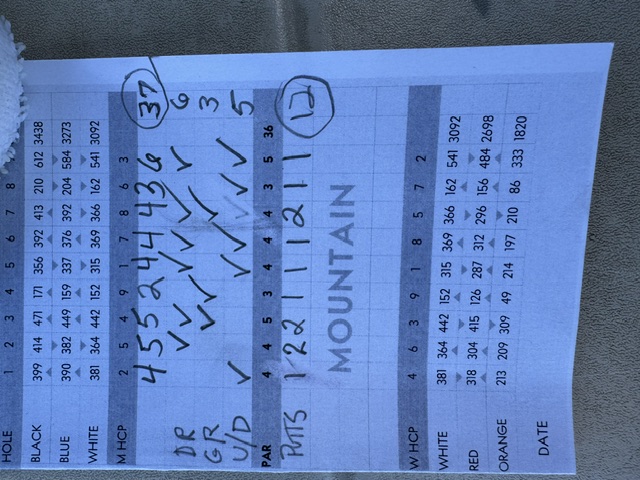
Here's the scorecard from the tournament Chris won. Look at it carefully:
He hit only 5 greens.
He scrambled the rest.
29 putts. 5-for-6 up-and-down. Two birdies — both saved from off the green. Driver and 7-iron untouched. That's not luck. That's the prescription working.
You'll work the system with your coach from home. And once a year, you fly out and spend two days with me at the campus …
I built a real-world scoring training facility
For twenty years I taught at other people's facilities. Range here. Green over there. Short-game area across town. You can't teach scoring like that. So I built one.
Eighty acres in Edmond, Oklahoma. Designed end-to-end around how a golfer actually improves. The campus I always wanted and could never find. I build Golfers, not golf swings — and this is where I do it.
The Short Game Lab
A complete short-game complex. Chipping and pitching off real grass — not mats. Every lie you'll face on a real course. Plus every variation of bunker shot, from real sand.
And one feature I don't know of anywhere else in golf:
This is where 75% of your scoring happens. And it's where I see students drop their handicap the fastest.
Home of The Short Game School
Tour-Level Greens
Bent grass. Tour-quality. Every kind of break and speed you'll face on tournament Sunday.
AimPoint-ready. Multiple slopes, multiple grain directions, every kind of putt your home course can throw at you. 42% of your scoring lives here. Most golfers spend almost no time on it.
Home of The Short Game School & The AAI Mental Game School
The Infinity Course
Six holes. Two par 3s, three par 4s, one par 5. Designed so I can put a student in any situation a tournament could throw at them: side hill lies, ball above the feet, fairway bunkers, the punch under the tree, the high shot over it.
And here's the trick — those six holes can be routed twenty-seven different ways. Different tees, different angles, different pin positions. You won't play the same course twice in a week.
This is where the long game meets the short game. Where you stop practicing and start playing — under real conditions, with real consequences.
Home of The Playing School & The AAI Mental Game School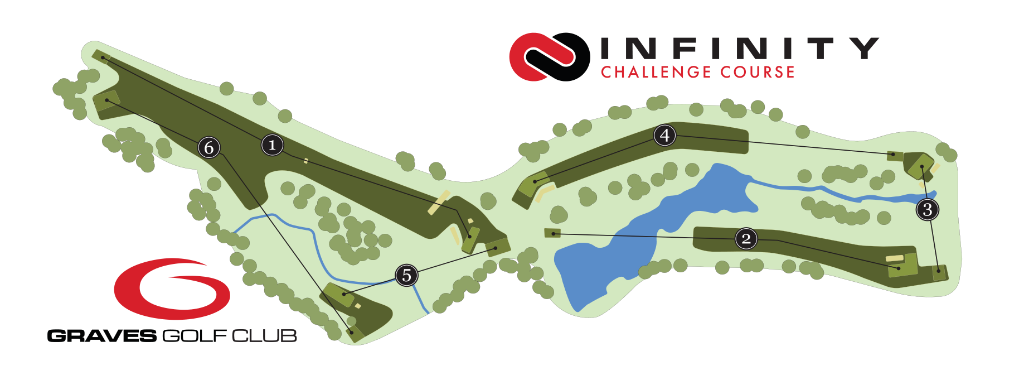
The infrastructure behind the data
The reason the system works isn't just the grass. It's that every shot you hit here is measured — and the measurements are honest.
The TopTracer Grass Range
Hit off mats and the data lies. Ball compression is wrong, spin numbers are off, launch angles don't translate.
Hit off real Bermuda and the data is gospel. Every shot tracked, every yardage real, every number you take home is one you'll see on the course.
This is where the home practice meets the real game. No mat numbers. No guessing.
Honest Data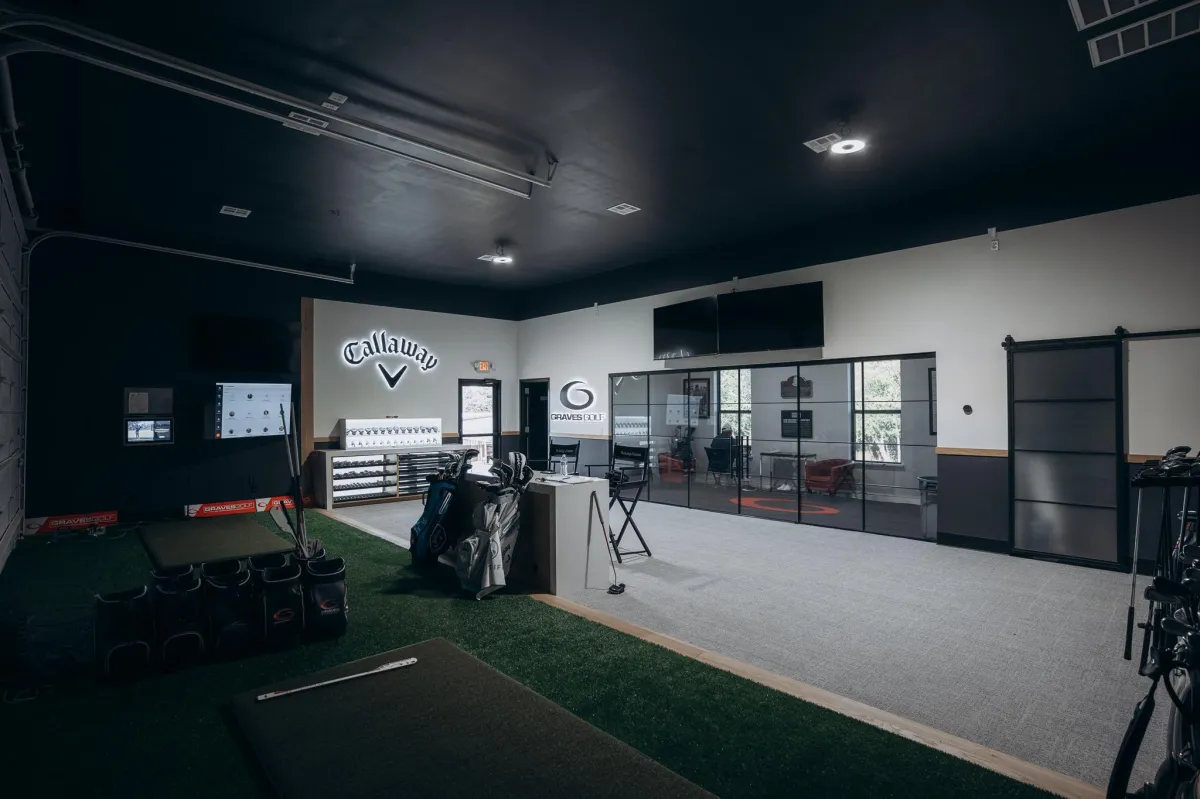
The Indoor Performance Center
Climate-controlled hitting bays. Air-conditioned, heated teaching building. Practice never stops here — not for rain, not for Oklahoma heat, not for January cold.
It's also home to our Callaway Certified Custom Fitting Center — the same fitter your tour player uses, on the same ground where you'll practice with your new clubs.
And the indoor classroom where students review data with their coach between sessions.
Callaway Custom FittingFour times a year, I run three intensive schools on this campus. I call them the Trifecta — because together they cover the three things that actually move your score.

The Short Game School
My favorite school to teach, and the one where students see the fastest improvement. Two days inside the scoring areas — putting, chipping, pitching, bunker — plus AimPoint green reading on our bent-grass green. Practical drills you take home. Real shots you'll actually face.
The Playing School
Take everything to the course. Two full days running every situation that costs golfers strokes — side hill lies, ball above feet, fairway bunkers, punches under trees, high shots over them. You stop drilling and start playing.
The AAI Mental Game School
Moe Norman called it the Alert Attitude of Indifference — total focus over the shot, complete detachment from the result. Co-taught with performance specialist Paul Monahan. Two days learning to be your own best caddy.
This is what a Trifecta graduate looks like
Tom Considine came through all three schools. Short Game. Playing. AAI. Last weekend — fresh off the Trifecta — he sent me this at 4:18 on a Sunday afternoon:
I am Yippee Skippying all around the golf cart. Had to send this off to you. Now heading to the range to work on mid irons.
All the best and thank you for all of your encouragement,
"Just by eliminating the three putts gave me a back nine score of even Par. Never ever have I even been close to that. Clearly balance, tension, tempo on those shots has helped significantly."
You probably want to know who's behind all this. Let me introduce myself properly …
Meet the Scoring Professor

A student gave me the title — I never asked for it
A few years back, a student walked in for what he thought would be a swing lesson. Low single-digit handicap. Sixty-something. Wanted to break par before he turned seventy.
We never made it to the range.
I spent the first hour at a table going through his assessment data. Putts inside ten feet. Up-and-down percentage from rough versus sand. Greens by approach distance. Where his strokes were actually leaking — not where he thought they were.
About halfway through he leaned back, looked at the spreadsheets and bar charts spread across the table, and said:
I laughed. I wrote it in my notebook. The next week another student used the same word without prompting. Then a third. By the end of that month it was on a name tag at a school. I stopped fighting it.
Instructor
rounds analyzed
campus
in 40 days
"Most instruction starts with the swing. I start with your scorecard. Then we go fix wherever the data points — short game, swing, both. The point is to lower the number on Sunday."
Now — let me make this even easier for you. Because I'm willing to take all the risk myself …
Five strokes in thirty days
Or it's free until you do
Apply. Get accepted. Run the system. If you don't shave five strokes off your game in the first thirty days, your enrollment is free until you do.
I keep coaching you. Free. Until you get the result. Because if my system doesn't work for you, you shouldn't pay for it — and I shouldn't sleep until I figure out why.
One more thing you should know about how this works …
This is application-only — on purpose
I turn away more applicants than I accept. Not because I'm picky. Because I guarantee results — and I can only guarantee results to students who'll actually do the daily work.
Ten minutes a day. Six weeks at a time. If you're not ready for that, I respect you for it — and I'm not the right coach for you. Apply anyway. Ryan Westrick, my Enrollment Advisor, will route you to something that fits better. No hard feelings.
If you are ready — get your application in. Ryan reviews every single one personally. If your goals match what I do, you'll have a twenty-minute discovery call with him within twenty-four hours.
Are you in?
Application takes about five minutes. Ryan responds within twenty-four hours. If we're a fit, you'll have a discovery call on the calendar before the week is out.
To your best golf,
Tim Graves